INTERDEM Academy – Annual report 2024

Date: January 2025
Authors: Dr Fania Dassen, Prof dr Frans Verhey, Caitlin Hibbs, MSc, Dr Sara Laureen Bartels, Dr Esther Loseto-Gerritzen
Content
- INTERDEM Academy Network and Membership
- Management Structure
- Further collaborations
- Activities and events 2024
- In-person Masterclasses with HOMEDEM consortium
- Webinars
- Alzheimer Europe 2024
- Publication award 2023-2024
- Annual travel fellowship – call 2024-2025
- MENTORDEM programme
- Funding
- Dissemination
- INTERDEM Academy Network and Membership
INTERDEM Academy is part of INTERDEM, an international European interdisciplinary excellence research network of 600+ leading academics and researchers in more than 20 European countries with the aim to stimulate research that improve early detection and timely and quality psychosocial interventions in dementia. INTERDEM Academy specifically aims at equipping European early-career dementia researchers (ECDRs) with essential dementia-specific and transferable knowledge and skills, to prepare them to adopt senior roles, and thus to secure capacity building in the future.
Recently, the INTERDEM board decided to have a more integrative approach towards Academy members and see them as part of the full INTERDEM network.
What we did in 2024:
- In collaboration with HOMEDEM, in 2024, we organized 3 in-person masterclasses on dementia care, design and policy.
- We initiated a mentorship programme with the senior INTERDEM network to facilitate ECDRs adopting senior roles. This programme is called MENTORDEM.
- In addition, we offered ECDRs the opportunity to join one of the INTERDEM Taskforces, to attend the annual INTERDEM business meeting.
- As part of a memorandum of understanding of INTERDEM with Alzheimer Europe, we hosted an Academy session specifically targeted at ECDRs as part of the official program of the annual Alzheimer Europe conference, focusing on ‘Grants, networking and brilliant failures’.
- We hosted online webinars: one webinar on “Towards Bridging the Gap between Research and the Community”, and two Taskforce Spotlight webinars.
- Our annual travel fellowship was granted to Marine Markaryan, which will allow her to spend 1-3 months in another psychosocial research center in 2025, for the exchange of knowledge and experience between (INTERDEM) centers.
- We allocated our annual INTERDEM Academy Publication award to Jacoba Huizenga. She was invited to give a presentation about her work during the annual INTERDEM business meeting.
- In collaboration with the Alzheimer Europe Foundation, INTERDEM Academy granted 10 bursaries to ECDRs from low- and middle-income countries in Europe, to attend the Alzheimer Europe conference for free to present their innovative approaches to dementia in a Dementia Researchers of the future special lunch symposium.
In December 2024, the Academy network has grown to 353 ECDRs from all over Europe (including some members based outside of Europe). The Academy still has the strongest fundament in the UK, see figure 1 for members per country. Last year, 43 ECDRs joined our network, whereas only few have left the network (by changing research field or job). At our annual business meeting in 2024, three Academy members became an INTERDEM full member and presented their research interests.
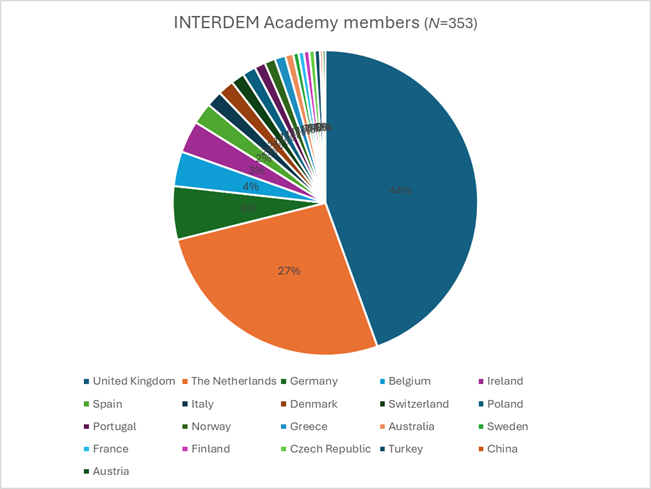
Fig 1. Country distribution of INTERDEM Academy members.
Members per country: United Kingdom 157, The Netherlands 94, Germany 20, Belgium 13, Ireland 12, Spain 8, Italy 6, Denmark 6, Switzerland 5, Poland 5, Portugal 4, Norway 4, Greece 4, Australia 3, Sweden 2, France 2, Finland 2, Czech Republic 2, Turkey 2, China 1, Austria 1)
- Management structure
The INTERDEM Academy is managed by an Executive board (4 members) for the day-to-day running activities, with weekly meetings, and supported by a management board with currently 7 members. The Management board of INTERDEM Academy has had three online meetings in 2024. The International Advisory board has met once online (22nd of February 2024).
In December 2024, two new junior representatives joined the INTERDEM Academy Management Board.
Executive Board:
- Frans Verhey – project chair
- Sara Bartels – chair elect
- Fania Dassen – project manager
- Caitlin Hibbs – project support
Management Board
- Marjolein de Vugt – INTERDEM chair
- Martin Orrell – Academy advisor INTERDEM Board
- Charlèss Dupont – late-stage representative (2nd term)
- Eithne Heffernan – late-stage representative (2nd term)
- Esther Loseto-Gerritzen – Academy representative INTERDEM board
- Ajda Flisar – early-stage representative (1st term)
- Felix Wittmann – early-stage representative (1st term)
International Advisory Board
- Iva Holmerová, Prof of Geriatric Medicine at Prague University, and former director of Alzheimer Europe.
- Marco Blom, scientific director from Alzheimer Netherlands
- Dianne Gove, Alzheimer Europe, director for Public Involvement and Ethics
- Further collaborations
- INTERDEM Academy board members Sara Laureen Bartels and Esther Loseto-Gerritzen have initiated an informal collaboration with ISTAART PEERs, entailing a working group that meets online every month (since 2023), to discuss topics on early career needs and support. One of the main outcomes in 2024 was an open access article published in Alzheimer’s & Dementia: Dupont, C., Gilissen, J., Dassen, F. C. M., Branco, R. M., Heins, P., Heffernan, E., & Bartels, S. L. (2024). Supporting early-career dementia researchers: Identifying support needs and ways forward via a European study. Alzheimer’s & Dementia, 20(2), 1321-1333. https://doi.org/10.1002/alz.13530. The Open access fee was kindly covered by ISTAART.
- In 2025, we will continue this collaboration.
- The HOMEDEM collaboration covers costs for 1-2 in person masterclasses per year, as part of the HOMEDEM training weeks (5 schools in total; 5th, final Masterclass in May 2025). Participation in these Masterclasses is free of charge for INTERDEM Academy members (for a maximum of 20 Academy members). In 2024, three Masterclasses took place, in Eindhoven (the Netherlands), Milan, (Italy), and Aveiro, (Portugal) (see activities and events for details).
- We continued our collaboration with the Alzheimer Europe foundation, in selecting and providing 10 bursaries to early career researchers from low and middle income countries, to attend the conference and present their innovative approaches to dementia research (10 x 1000euro).
- SPIN-D Network+ was formed in 2024 and is supported by the National Institute for Health Research (NIHR), Alzheimer’s UK and UKRI Economic and Social Research Council (UKRI ESRC). SPIN-D seeks to connect people together whose aims are to prevent dementia through behaviour change across three forms of prevention from the Care Act 2014. This includes: 1. Prevent primary dementia, 2. Delay dementia symptoms with secondary prevention, 3.Reduce the impact of dementia through tertiary prevention. One aspect of the network’s efforts is supporting ECDRs working in these areas through providing or highlighting funding, networking and learning opportunities. We are currently discussing opportunities for joined activities (e.g., annual webinar and annual in-person masterclass).
- Activities and events 2024
- In-person Masterclasses with HOMEDEM consortium
| HOMEDEM Masterclass Technology, Research and Design in Dementia Thursday 1 February 2024, Eindhoven, the Netherlands This in-person masterclass was part of the 2nd HOMEDEM training week. This Masterclass was hosted by Eindhoven University of Technology and co-hosted by Maastricht University (the Netherlands). | HOMEDEM Masterclass at University of Aveiro, Portugal, on September 30 and October 1, 2024. Theme day 1: Lectures on caregiving support and reminiscence + workshop on data visual representation Theme day 2: Lectures on person-centered dementia care and economics of psychosocial care + workshop on evaluation in design research |
| HOMEDEM Masterclass at Politecnico di Milano, Italy, on May 13 and 14, 2024 Theme Day 1: Service design and care ecosystems Theme Day 2: Healthcare policy & design 2 external INTERDEM Academy members attended the event. | The next, final masterclass in collaboraton with HOMEDEM will be in Galway, Ireland, in May 2025. For this final event, a link to a livestream will be made available to our Academy members, so online participation is possible as well. |
- Webinars
SPOTLIGHT Webinar series
Our first regular online activity, initiated during the COVID-19 pandemic, was the online Academy Café, where European ECDRs could learn about a topic and network in breakout rooms. We noted a decrease in popularity of this online event, as sign-ups decreased, no new requests for topics were submitted, and an increasing number of last minute cancellations and no show appeared.
In 2023, an alternatve was launched by Esther Loseto-Gerritzen and Sara Laureen Bartels, known as the Spotlight Webinar series. In this new series, one of the INTERDEM taskforces leads takes the spotlight and prepares an informative and interactive session for the whole network of both INTERDEM and Academy members. This session is preferably led by one senior and one junior member of the taskforce, and facilitated by the INTERDEM Academy coordinator and representatives. To highten attendance and lower numbers of no show, duration of one webinar was reduced to either 1,5h or 1h (instead of 2h), and an outlook-invite with Zoom-link is sent out directly to all INTERDEM and Academy members 2-3 months in advance.
- Friday 8 March 2024 – Taskforce Methodology
- Presenters: Maud Graff, Lieve van den Block, Nathan Stephens
- 40 attendants, approx. 1/3 interdem senior
- Evaluation: Added a 10 minute break this time. Very positive feedback
- INTERDEM-website blog post: https://interdem.org/?p=8761
- Friday 14 June 2024 – Taskforce Technology
- Presenters: David Neal, Lizzy Boots and Thomas Engelsma.
- No data on attendance has been registered.
- Thursday 19 September – a late- breaking webinar with Golnaz Atefi, #Rolling for Dementia: “Towards Bridging the Gap between Research and the Community”.
- Presenters: care veteran Ton in ‘t Veen & Diana Karamacoska
- 38 attendants
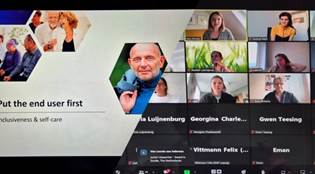
Fig 2: Screenshot of the online webinar “Towards Bridging the Gap between Research and the Community”
- Next SPOTLIGHT Webinar:
- Taskforce Inequalities in Dementia Care, February 2025
- Alzheimer Europe 2024
- Taskforce Inequalities in Dementia Care, February 2025
The 34th Alzheimer Europe conference “New horizons – Innovating for dementia” was organised from 8 to 10 October 2024 in Geneva, Switzerland.
Every year, INTERDEM Academy is allocated one of the INTERDEM timeslots at the AE conference. This year, the INTERDEM Academy session focused on funding, networking, and brilliant failures: P03 It’s not all about the money – tips and tricks to get your research ideas funded (Tuesday 8th of October, INTERDEM timeslot 15.45 – 17.00pm). Presenters shareing their personal career and tips and tricks were an Academy PhD-student (Golnaz Atefi, Maastricht University), a postdoctoral researcher and new full INTERDEM member (Hannah Christie (Dublin), a recently appointed professor from INTERDEM (Seb Kohler, Maastricht University), and a INTERDEM researcher with experience in reviewing (Alys Griffiths University of Sheffield). The session was well attended and participants engaged actively in Q&A.
- For the first time, INTERDEM (Academy) had an exhibition stand with 1-2 members offering to provide insight into INTERDEM and INTERDEM Academy activities to conference attendees. The stand included a banner with QR codes to facilitate registration. Many early-career researchers visited the booth to learn more about Academy membership and opportunities, and current INTERDEM and Academy members visited the booth to ask questions or socialize. 9 new Academy members signed up during the conference itself (from the UK, Belgium, Netherlands, Italy, Turkey, and Switzerland). Prining costs of the flyer and banner were kindy funded by the University of Nottingham
- At the Alzheimer Europe conference, a special lunch-symposium was held, to present the work of the ten ECDRs from low – middle income EU countries who were selected by our jury in July, to benefit from the bursaries provided by the Alzheimer Europe Foundation to attend and present at the 34rd Alzheimer Europe Conference. The selection of the ten bursaries was based on the best average scores each received from the jury members from INTERDEM and Alzheimer Europe. The session, called “Dementia Researchers of the future”, was chaired by Iva Holmerová (Czech Republic) and Fania Dassen (Netherlands). This symposium was organised by the Alzheimer Europe Foundation and the INTERDEM Academy thanks to the support of the silver sponsorship of Biogen.
Presenters/bursary winners:
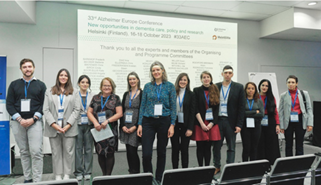
Fig 3. Picture taken at Alzheimer Europe of co-chairs Iva Holmerová and Fania Dassen, and the 10 bursary winners.
- Publication award 2023-2024
- The INTERDEM Academy executive office checked eligibility, and a jury of at least two senior INTERDEM (board) members and at least one Academy representative (to get the chance to practice reviewing skills within the idea of ‘adopting senior roles’) reviewed and ranked all applications.
- 10 articles received.
- Pre-screening: Caitlin Hibbs and Niels Janssen (executive office) – all articles were elegible, and on global assessment, no pre-selection could be made: all articles were equally suitable: therefore, 10 articles were forwarded to the jury.
- Jury: Georgina Charlesworth (INTERDEM, head of jury), René Thyrian (INTERDEM), Joost Wammes (Academy, winner of last year), Charless Dupont (Academy representative).
Outcome:
2. Runners-up (in alphabetical order)
- Jem Bhatt – The development and validation of the Discrimination and Stigma Scale Ultra Short for People Living with Dementia (DISCUS-Dementia)
- Naomi Thompson – Investigating the impact of music therapy on two in-patient psychiatric wards for people living with dementia: retrospective observational study
1. Winner of this year:
Jacoba Huizenga – “What matters most: Exploring the everyday lives of people with dementia” (see https://doi.org/10.1002/gps.5983).
- Jacoba is a PhD student at the Utrecht University of applied sciences, the Netherlands. The jury was unanimously in selecting this paper as winner. At the annual INTERDEM meeting connected to the 34th Alzheimer Europe Conference in Geneva, Jacoba Huizenga presented her article together with a member of the EWGPWD and Brain power group: Gerda van Tongerloo. Besides the publicity and opportunity of presenting her work, Jacoba also won a price of 1000 euros as a boost for her career. Both runner ups won 500 euro to be used to boost their career.
- Blog winning articles: https://interdem.org/?p=8840
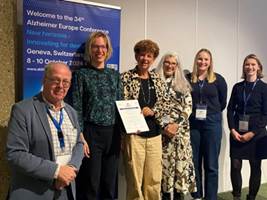
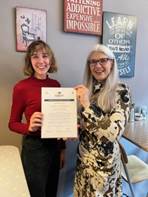
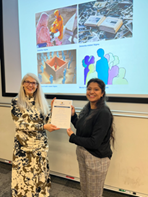
Fig 4. Publication award winner Jacoba Huizenga, together with Brain Power and EWGPWD member Gerda van Tongerloo, and the INTERDEM Academy executive office, and chair of the jury, Georgina Charlesworth (l), Georgina Charlesworth and runner-up Naomi Thompson (m), Georgina Charlesworth and runner-up Jem Bhatt (r)
- All winners of 2024 have to share their plan for spending the money. For one of the runner up of last year, Federica D’Andrea, the plan for spending is still pending .
- The call for the next publication award will open in Q1 of 2025. There are no intended changes to the procedure.
- Annual travel fellowship – call 2024-2025
- The INTERDEM Academy enables an annual travel Fellowship for Academy members, allowing them to attain experience in another psychosocial research center, to build their network and stimulate career development. Our grant covers expenses for travel and housing for a research exchange of 1–3 months, up to a maximum of €3500.
- The INTERDEM Academy executive office checks eligibility, and a jury of at least two senior INTERDEM (board) members and at least one Academy representative (to get the chance to practice reviewing skills within the idea of ‘adopting senior roles’) reviews and rank all applications.
- Last year, after internal evaluation, te fellowship procedure was revised (duration of 1-3 months instead of 3-6, all psychosocial centra can be visited, all Academy members can apply, specific fellowship opportunities and host centra offered, open format motivation letter with focus on added value for candidate and career, home and host institute, and broader INTERDEM network. The list of potential host-centra and their topic offered online was extended this year.
- Jury: Rabih Chattat (INTERDEM board), Esther Loseto-Gerritzen (INTERDEM Academy rep INTERDEM board) and Eithne Heffernan (late-stage rep Academy)
- Note: Sara Bartels agreed to be a jury member as well, but given her direct involvement with one of the candidates (daily supervisor), we mutually agreed that she would refrain from assessment this year, to make sure no bias would be introduced.
Criteria:
- 1. Quality of the applicant, 2. Quality of the research activity plan, 3. Added value for institutes involved, 4. Added value for the applicant’s network and career development.
Outcome:
- 4 applications were sent in, all considered elegible after the precheck by the executive office.
- One candidate stood out, receiving the highest ratings overall, and rated 1st place by 2 out of 3 jury members: Marine Markaryan. This made it possible for the executive office to choose the winner based on written assessment only (no follow-up in person discussion needed). All jury members agreed with Marine as winner.
- Marine is a PhD-candidate in the HOMEDEM consortium, based at Maastricht University. She will visit the Dementia Services Development Centre (DSDC) at Bangor University for 9 weeks, to conduct interviews with people with dementia for the project ‘Sustaining couplehood in the face of dementia’.
- After completion of her exchange, Marine will write a blog about her experiences to be published on the INTERDEM website.
- MENTORDEM Programme
Successful pilot (3 couples) from April – September 2023, lessons learned:
Mentor and mentee from different country
- Not necessarily only senior mentors
- Guidance provided by us seemed adequate
MENTORDEM Programme
December 2023: Call for Mentors (n=21)
- Provided short introduction about themselves and their career
- Both seniors and mediors could sign up to be a mentor
January 2024: Call for Mentees (n=20)
- Provided information on current position
- Explained what they were looking to gain from this mentorship
- Could mention any preferences like gender or medior/senior
20 mentor-mentee pairs were formed
- Mentor and mentee from different country
- Carefully matched on preferences and goals for the mentorship
Short online evaluation summer 2024:
Email to all participants: “Briefly share your impressions of the MENTORDEM programme as a mentor/mentee so far. How is it going, and has it met your expectations?”
Overall positive responses:
- “Really insightful and inspiring.”
- “Exceeded my expectations.”
- “It’s a two-way street for mentor and mentee.”
- “The programme has more flexibility and is more specific to my field than other mentor schemes I came across in the past.”
International aspect appreciated:
- “I’ve learned a lot about different academic systems.” (n=2)
Matching worked out well:
- “We were well matched”
- “The most excellent pairing is what has been the magic to me.”
- ”Very good match I feel with a lot of synergy.”
Content:
- “I received many tips on how to navigate the academic landscape and manage my position in between different fields.”
- “We discussed matters related to academia and life.”
- “My mentor provided me with great exercises to reflect on my own career path.”
- “It gave me an opportunity to ask questions that I might not be comfortable discussing with my supervisor.”
- “My mentor could give input from a different, neutral stance.”
Negative responses (n=2):
- ”Has not met my expectations: due to planning issues.”
- “Unfortunately, my mentee didn’t reach out to me.”
Tips for improvement:
- “As a mentor, I would like some more formal training and tools (e.g., exercises, reflective questions.”
- “MENTORDEM could clarify the roles and responsibilities for mentors, by making it more concrete with reasonable and unreasonable examples”
Continuation:
- “I am very happy my mentor keeps willing to continue to schedule meetings.”
- “I can continue to stay in touch.”
- “I would be very happy to continue to support my mentee and others through the programme.”
2nd round – call for mentors and mentees, followed by matching procedure – Q1 2025
- Funding
With the continuous support of the INTERDEM Network and INTERDEM projects (e.g., HOMEDEM, SPREAD+), Alzheimer Europe, the continuous in-kind support of Maastricht University, and an annual grant of €20.000 of the Dutch Alzheimer Society Alzheimer Nederland (until 2027), we have been able to continue to finance the basic structure of our network.
Current grants
- Alzheimer Nederland (Reference: WE.15-2022-05/u220135/MB/eb)
The Alzheimer Nederland funding is currently used to fund the coordination of the network.
Current collaborations for hosting ECDR activities
- HOMEDEM consortium
- SPIN-D Network+
Pending grants
- Open proposal – Haydn Green Foundation, Nottingham, UK
- Dissemination Activities
- Introduction INTERDEM at HOMEDEM Masterclass 2
- Introduction INTERDEM Academy at HOMEDEM Masterclass 3
- Update presentation at annual INTERDEM business meeting, preceding the 34th Alzheimer Europe conference
- INTERDEM booth at 34th Alzheimer Europe conference
- INTERDEM Banner
- INTERDEM-flyer in conference bag.